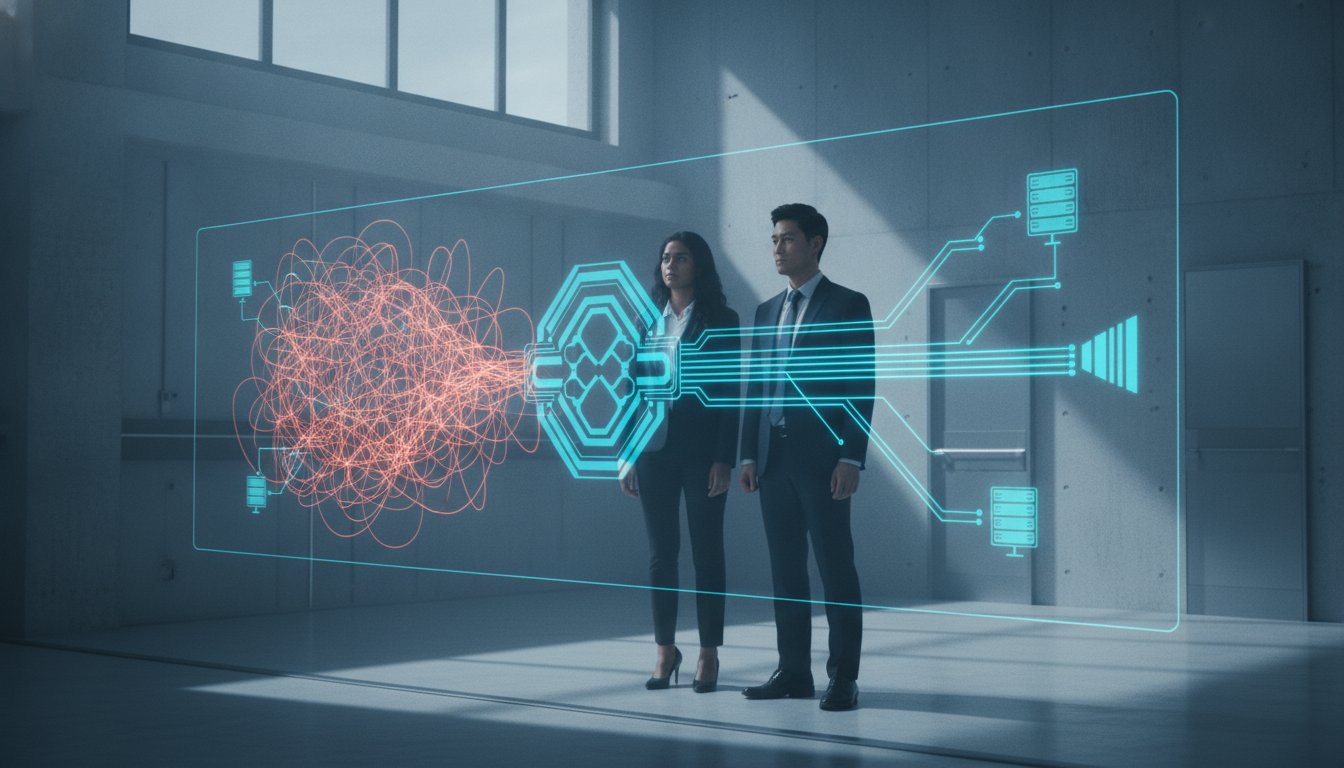
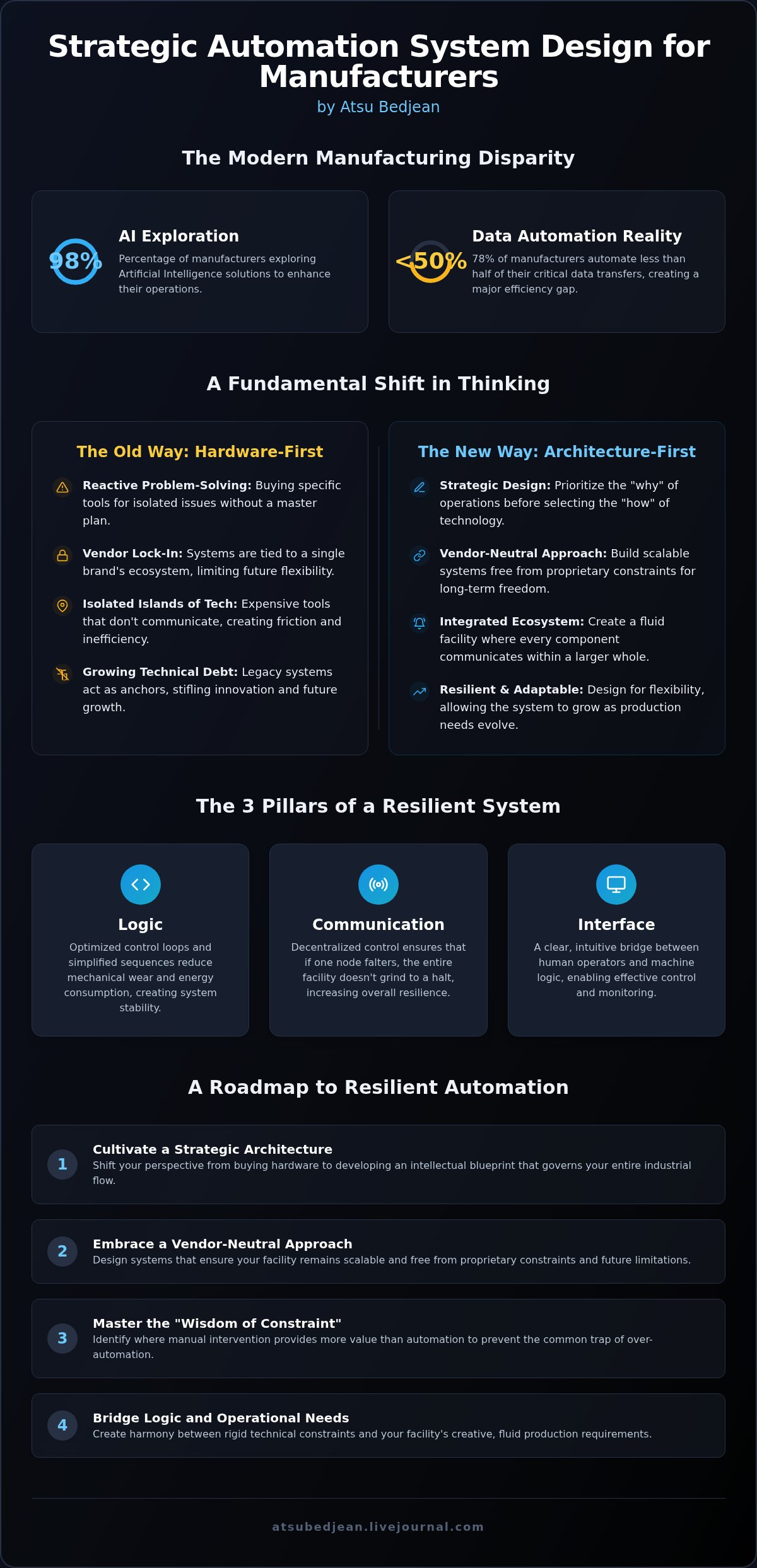
While 98% of manufacturers are exploring AI in 2026, a staggering 78% still automate less than half of their critical data transfers. This disparity often reveals a focus on hardware rather than the underlying logic that holds a system together. You've likely felt the friction of legacy systems that act more like anchors than engines, creating a technical debt that stifles innovation. It's a delicate balance to align your creative operational goals with the rigid constraints of traditional machinery, often leading to the "over-automation" trap where complexity outpaces utility.
This article offers a path forward through strategic automation system design for manufacturers, shifting the focus toward resilient, vendor-neutral architectures. You'll discover how to move beyond hardware-centric thinking to create scalable, efficient systems that stand the test of time. We'll explore a methodical roadmap that transforms your facility into a fluid ecosystem through optimized control loops and disciplined logic. By the end, you'll have the clarity needed to build a system that values the "why" of your operations as much as the "how," ensuring your industrial architecture is ready for future growth.
Key Takeaways
- Shift your perspective from purchasing hardware to cultivating a strategic intellectual architecture that governs your entire industrial flow.
- Implement a vendor-neutral approach to automation system design for manufacturers to ensure your facility remains scalable and free from proprietary constraints.
- Master the "Wisdom of Constraint" by identifying where manual intervention provides more value than automated logic, preventing the common trap of over-automation.
- Follow a methodical, phased roadmap to transition from legacy technical debt toward a resilient system built on optimized control loops.
- Learn how to bridge the gap between rigid technical constraints and your facility's creative operational needs for a more harmonious production environment.
Beyond Hardware: The Philosophy of Automation System Design for Manufacturers by Atsu Bedjean
True automation doesn't begin on the factory floor with a pallet of sensors or a new robotic arm. It starts in the mind as a conceptual blueprint. We often mistake the physical components for the system itself, but automation system design for manufacturers is actually the intellectual architecture that governs industrial flow. In 2026, the era of isolated machinery is fading, replaced by integrated ecosystems where every node communicates within a larger whole. This transition requires a move from hardware-first thinking toward an architecture-first strategy. When we prioritize the logic before the metal, we achieve a state of "Engineering Elegance" in industrial environments, where the solution is as simple as possible but no simpler. It's about creating a bespoke industrial architecture that feels natural and intuitive rather than forced and mechanical.
The Shift from Manual to Intelligent Workflow
The transition from manual processes often stumbles when a clear design roadmap is absent. Many manufacturers rush to solve a labor shortage or a quality issue by purchasing a specific tool without asking "why" that tool is necessary. Without a foundational Industrial control system strategy, these tools become expensive islands of technology that don't talk to one another. Identifying the operational "why" before selecting the technical "how" is essential for long-term stability and control system technical precision. Resilient design is the ability to adapt to variability without system failure. By building flexibility into the initial design, you create a system that can grow as your production needs evolve.
Why Manufacturers Need an Independent Perspective
There's a subtle but significant conflict of interest when hardware vendors lead your automation journey. Their primary goal is often to sell specific products, which can lead to proprietary "lock-in" where your future growth is tethered to a single brand's ecosystem. An independent consultant acts as a bridge-builder between technical rigor and your creative operational goals. This neutral advisor prioritizes your facility's efficiency over hardware sales, offering a vendor-neutral lens that protects your interests. This perspective is often enriched by expertise in building automation and system architecture, providing a holistic view of how different systems interact. In a cross-functional team, this approach ensures that automation system design for manufacturers remains a tool for empowerment rather than a source of technical debt. It allows you to maintain the fluidity of creative thought while respecting the structure of technical discipline.
The Core Pillars of Resilient Industrial Control Architecture by Atsu Bedjean
A resilient system is built on three essential pillars: logic, communication, and the interface. While many see these as separate technical tasks, they are the vital organs of a unified body. In the context of automation system design for manufacturers, these layers must work in harmony to ensure that the system doesn't just function, but thrives under pressure. According to the NIST definition of ICS, these systems encompass the hardware and software that support critical infrastructure. In 2026, the shift toward Distributed Control Systems (DCS) has redefined how we view these pillars. By decentralizing control, we increase resilience; if one node falters, the entire facility doesn't grind to a halt. This modularity is the secret to a truly scalable architecture that allows for growth without the need for a total system overhaul.
Logic Optimization and Control Loops
Refining PID loops is more than a technical requirement; it's a form of stabilization that impacts the physical longevity of your equipment. When logic is optimized, mechanical wear is significantly reduced because the system isn't constantly over-correcting. This precision also leads to lower energy consumption, as motors and actuators operate only when necessary. There's a "Quiet Art" in simplifying complex control sequences. The most sophisticated designs are often those that remove unnecessary steps, creating a fluid operational flow that's easy to troubleshoot and maintain. If you're looking for ways to refine these processes, exploring Control System Optimization can provide the clarity needed to move forward.
Communication Networks and Data Integrity
The second pillar, communication, acts as the nervous system of the facility. For automation system design for manufacturers to succeed, data exchange between sensors and PLCs must happen with extremely low latency. Electrical noise and signal interference are constant threats in industrial environments, but a resilient architecture accounts for these variables through shielding and robust protocol selection. By standardizing communication protocols, we achieve vendor-neutral scalability. This approach prevents the proprietary lock-in mentioned earlier, allowing different machines to speak the same language. When data integrity is prioritized, the gap between the physical reality of the floor and the digital logic of the controller disappears, resulting in a system that is both precise and reliable.
Navigating the Over-Automation Trap: Balancing Complexity with Operational Flow by Atsu Bedjean
Manufacturers often hesitate to embrace new technology, not because they lack ambition, but because they fear the weight of added complexity. This concern is valid. When automation system design for manufacturers is approached without restraint, it can lead to systems that are too rigid to adapt and too convoluted to repair. True innovation requires the "Wisdom of Constraint," which is the disciplined practice of recognizing when a manual process is actually more resilient than an automated one. We must ask if a process *should* be automated before we ever discuss *how* to do it. This reflective approach ensures that every layer of logic serves a clear purpose, moving us toward intelligent hyper-automation for smart manufacturing without sacrificing the intuitive flow of the factory floor.
Identifying and Minimizing Technical Debt
Technical debt in an industrial context is the future cost of today’s sub-optimal design choices. It often begins with "quick fixes" in control logic or undocumented patches that solve a temporary crisis but create a permanent maintenance burden. When these shortcuts accumulate, they act as a tax on future productivity, making even simple upgrades feel insurmountable. Resilient automation system design for manufacturers prioritizes clean, standardized architecture and documented code from the outset. By investing in technical precision today, you avoid the compounding interest of a system that becomes increasingly difficult to manage over time.
Operational Excellence through Bottleneck Analysis
Operational excellence isn't achieved by replacing humans, but by designing systems that support them. A thoughtful system design uses bottleneck analysis to identify both physical and logical constraints that slow down production. Is the delay caused by a machine's cycle time, or is it a lag in data communication? By isolating these friction points, we can apply automation exactly where it's needed most. This ensures that the technology acts as a catalyst for human creativity rather than a barrier. Before implementing any change, conducting a thorough automation feasibility study allows you to justify system adjustments with data rather than intuition, ensuring that every new control loop contributes to a more fluid and efficient ecosystem.
Developing a Scalable Roadmap for Manufacturing Automation by Atsu Bedjean
A successful evolution doesn't happen by accident. It's the result of a deliberate, phased journey that transforms legacy constraints into modern advantages. While some might suggest leaping directly into hardware acquisition, a more contemplative approach ensures that every change is rooted in long-term utility. Effective automation system design for manufacturers follows a three-stage progression that prioritizes stability before expansion. This methodical path allows us to address technical debt while simultaneously building for the future.
The first phase involves a deep analysis of your current state. We examine existing control loops and system stability to understand the baseline performance. In the second phase, we design the "To-Be" architecture, where scalability is treated as a core requirement rather than an afterthought. Finally, the third phase focuses on an implementation strategy that minimizes downtime and operational friction. By treating the transition as a narrative arc rather than a series of disconnected tasks, we maintain operational flow throughout the process. For those ready to begin this journey, engaging with Automation System Design Consulting provides the structured guidance necessary for a successful transformation.
The Lifecycle Management Perspective
Industrial environments operate on a different timeline than consumer technology. When we design a system, we must plan for a 10-15 year industrial lifecycle. This means creating an infrastructure that allows for future modernization without requiring a total teardown. Future-proofing isn't about predicting every technological shift; it's about building a modular foundation that can integrate new logic as it emerges. This long-term view ensures that your investment remains relevant as industry standards evolve, allowing for a graceful evolution of your facility's capabilities.
System Architecture Reviews and Audits
A design is only as good as its performance under pressure. Before any code is deployed, we perform a reliability audit on the proposed architecture. This process is a vital part of automation system design for manufacturers, as it validates the logic against real-world manufacturing variability. We ensure the system can handle the unexpected without compromising safety or regulatory standards. By subjecting the design to rigorous scrutiny during the planning stage, we prevent costly errors during implementation. This methodical validation bridges the gap between theoretical precision and practical reliability, resulting in a system that truly stands the test of time.
Atsu Bedjean: Bridging Logic and Imagination in System Design by Atsu Bedjean
The role of an automation engineer is often viewed through a purely mechanical lens, yet the most resilient systems require a deeper synthesis of logic and imagination. As a guide through complex industrial challenges, I approach every project with the understanding that technical precision is only half of the equation. My background in building automation provides a unique perspective on industrial environments, treating a factory floor not just as a collection of machines, but as a living ecosystem. This holistic view informs my approach to automation system design for manufacturers, where the goal is to create a seamless resonance between the physical space and the digital logic that controls it. By prioritizing control system optimization as a continuous pursuit of excellence, we move beyond static solutions toward architectures that breathe and adapt.
The Craft of Bespoke Industrial Architecture
Every facility possesses its own unique operational rhythm, a specific cadence of production that generic, off-the-shelf solutions often fail to capture. Why should your facility be forced into a rigid template designed for someone else? Bespoke industrial architecture is about tailoring the system to your specific needs, integrating disparate disciplines into a coherent technical vision. This process requires a reflective mindset that values the "why" of a process as much as the "how." It's a journey of technical mastery that encourages both professional and personal growth. When we bridge the gap between rigid technical constraints and the fluidity of creative thought, we create systems that don't just work; they thrive. This commitment to intelligent architecture ensures that your automation system design for manufacturers is a true reflection of your operational goals.
Next Steps: From Inquiry to Optimized Reality
A strategic lens often identifies opportunities for efficiency that hardware-centric vendors might overlook. While a salesperson might see a need for more sensors, a thoughtful advisor looks for ways to refine the existing logic to achieve peak technical precision. This methodical approach to refining systems ensures that every adjustment contributes to a more resilient and scalable future. Transitioning from a state of high technical debt to an optimized reality is a journey that begins with a single, purposeful inquiry. If you're ready to explore a vendor-neutral path toward a more efficient facility, you can consult with Atsu Bedjean on your automation architecture to begin the process of transforming your industrial landscape into a masterpiece of engineering elegance.
Cultivating a Future of Resilient Industrial Flow by Atsu Bedjean
The journey toward a truly resilient facility isn't a sprint toward the latest hardware but a steady, contemplative evolution of logic and architecture. By moving beyond isolated machinery and embracing a vendor-neutral philosophy, you protect your operations from the weight of technical debt and proprietary constraints. We've explored how a methodical roadmap, rooted in deep analysis and the "Wisdom of Constraint," ensures that your technology supports the human element of production rather than complicating it. This approach to automation system design for manufacturers prioritizes long-term stability over short-term fixes, creating an ecosystem that thrives on precision and adaptability.
As you look toward the next decade of production, remember that the most elegant solutions are often those that find harmony between rigid technical structure and the fluidity of creative thought. If you're ready to transition from fragmented legacy systems to a unified, intelligent architecture, I invite you to Explore Strategic Automation Consulting with Atsu Bedjean. Together, we can refine your control loops and optimize your industrial flow with an independent perspective that puts your facility's excellence first. The future of manufacturing belongs to those who build with intention, and your path to an optimized reality starts with a single, thoughtful step.
Frequently Asked Questions by Atsu Bedjean
What is the first step in automation system design for a small manufacturer?
The first step is conducting a thorough audit of your current operational flow and identifying the specific bottlenecks that hinder productivity. Instead of looking at hardware, you should focus on the underlying logic of your manual processes. This initial analysis allows you to define clear objectives for your automation system design for manufacturers, ensuring that any future technical implementation serves a precise purpose rather than adding unnecessary complexity to your facility.
How does control system optimization differ from simply upgrading hardware?
Control system optimization focuses on refining the intellectual architecture and logic sequences that govern your machinery, whereas hardware upgrades merely replace physical components. While new hardware might offer faster speeds, optimization ensures that the entire system operates with peak technical precision. This reflective process often involves stabilizing PID loops and simplifying communication protocols, which reduces mechanical wear and energy consumption without the high cost of a total equipment overhaul.
Can an automation system design be vendor-neutral?
Yes, a vendor-neutral design is achieved by prioritizing open communication protocols and standardized software architectures over proprietary hardware ecosystems. This approach prevents manufacturers from being locked into a single brand's lifecycle, allowing for greater flexibility when sourcing future components. By focusing on a bespoke industrial architecture that remains independent, you ensure that your system can evolve and scale without being tethered to a specific vendor's roadmap or pricing structure.
What are the most common risks of over-automation in manufacturing?
The primary risks of over-automation include excessive system complexity that outpaces the utility of the process and a significant increase in technical debt. When a design is too convoluted, it becomes difficult for human operators to troubleshoot, leading to extended periods of unplanned downtime. A thoughtful guide recognizes the "Wisdom of Constraint," knowing that automating a process that requires frequent human dexterity or creative intervention can actually decrease your facility's overall resilience.
How do I minimize technical debt when modernizing a legacy control system?
Minimizing technical debt requires a commitment to clean, well-documented code and a modular architecture that allows for incremental updates. You should avoid the temptation of "quick fixes" or undocumented patches that solve immediate crises but create long-term maintenance burdens. By treating automation system design for manufacturers as a long-term investment, you can build a foundation that supports future modernization without the need to tear down and rebuild your entire control infrastructure.
What is the role of an automation consultant versus a system integrator?
An automation consultant acts as a strategic architect who focuses on the "why" and the long-term roadmap, while a system integrator typically handles the physical installation and programming. The consultant provides an independent, vendor-neutral perspective to ensure the design aligns with your creative operational goals. This thoughtful guidance protects you from proprietary lock-in, ensuring that the final implementation by an integrator adheres to a resilient and scalable system architecture that prioritizes your facility's efficiency.
How long does a typical industrial automation feasibility study take?
The duration of a feasibility study depends on the complexity of your existing infrastructure, but it typically spans several weeks of methodical analysis. This period is used to validate logic against real-world variability and conduct a reliability audit on proposed changes. By taking the time to perform this deep dive, you ensure that any system changes are justified by data, ultimately reducing the risk of operational friction during the implementation phase of your project.
Why is system architecture more important than the specific PLC brand used?
System architecture is the foundational logic that governs how your facility functions, while a PLC is merely a component within that structure. A well-designed architecture survives multiple hardware lifecycles and remains resilient even as specific brands or models become obsolete. By focusing on the intellectual flow and communication layers, you create a system that values the integrity of the process over the label on the hardware, ensuring long-term scalability and operational excellence.